Which Claude model should I use? Fable 5.2, Opus 5.5, Sonnet 5.5 or Haiku 5.5
A plain guide to the four current Claude models in November 2026, what each costs, and a simple way to pick one and test it for your own project.
Saqqa Academy team
12-Nov-2026 · 6 min read
In this article
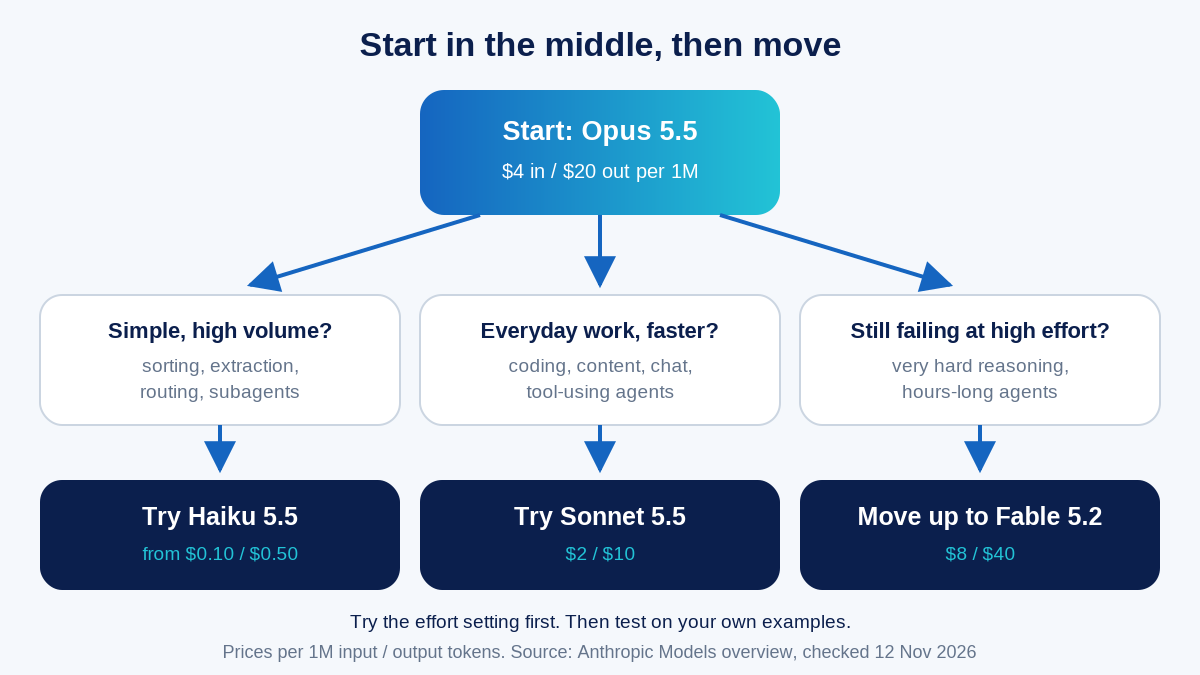
If you are not sure which Claude model to use, start with Claude Opus 5.5 (claude-opus-5-5). That is Anthropic's own advice for most work in November 2026. Move down to Sonnet 5.5 or Haiku 5.5 when you need lower cost or faster replies and your tests show they are good enough. Move up to Fable 5.2 only for very hard reasoning or agents that run for hours, after Opus 5.5 at a higher effort setting still falls short. Before switching models, try changing the effort setting first, because it often does the job for less.
Every fact and price below comes from Anthropic's Models overview and Choosing a model pages, checked on 12 November 2026. Prices change, so check them again before you plan a budget.
The four current models at a glance
All four take text and images as input, write text, support tool use, and have a 1 million token context window with up to 128K output tokens per request on the normal Messages API. Their reliable knowledge runs to June 2026. The differences are in strength, speed and price:
| Model | API ID | Best for (Anthropic's words, shortened) | Input / output price per 1M tokens | Default effort |
|---|---|---|---|---|
| Claude Fable 5.2 | claude-fable-5-2 | Demanding reasoning, long agentic work | $8 / $40 | high |
| Claude Opus 5.5 | claude-opus-5-5 | Long-running agentic coding and knowledge work | $4 / $20 | medium |
| Claude Sonnet 5.5 | claude-sonnet-5-5 | Best mix of speed and intelligence | $2 / $10 | high |
| Claude Haiku 5.5 | claude-haiku-5-5 | High-volume, fast tasks: classification, extraction, routing | from $0.10 / from $0.50 | medium |
Anthropic lists latency as moderate for Fable 5.2 and Opus 5.5, fast for Sonnet 5.5 and fastest for Haiku 5.5. Haiku's price says "from" because the overview page gives a starting price; see the pricing page for the details.
What each model is for, in plain words
Haiku 5.5: the fast worker. Think of jobs you do thousands of times: tagging support messages, pulling names and phone numbers out of text, deciding which team a message goes to, or acting as a small helper ("subagent") inside a bigger agent. It is the cheapest and fastest.
Sonnet 5.5: the everyday all-rounder. Anthropic suggests it for code generation, data analysis, writing content, understanding images and agents that use tools. If you are building a chatbot, a writing helper or a coding assistant that must answer quickly, try this first after Opus.
Opus 5.5: the default. Built for long agentic coding and knowledge work: big refactors, multi-hour coding agents, work with lots of images, and computer use. It costs twice as much as Sonnet per token, so check whether you really need it once your app works.
Fable 5.2: the top tier. Anthropic calls it its most capable model open to all customers, for agent sessions that run for hours, deep multi-step research, and analysis that ends in a finished document, spreadsheet or deck. It is twice the price of Opus 5.5, so use it where the extra quality truly matters.
Two ways to choose, step by step
Anthropic describes two starting approaches. Pick the one that fits your project.
Option 1: Start cheap (efficiency-first)
Good for prototypes, chat apps that must feel instant, and high-volume simple tasks.
- Build with Haiku 5.5.
- Test it on real examples from your users.
- If it fails on some cases, try Sonnet 5.5 on those cases.
- Upgrade only where there is a real gap.
Option 2: Start strong (capability-first)
Good for complex reasoning, maths, coding agents and anything where a wrong answer costs more than the tokens.
- Build with Opus 5.5.
- Improve your prompts for it.
- Test on real examples.
- Save money later by lowering effort or moving parts of the work to a cheaper model.
- If tests at
xhighormaxeffort still fall short on very hard tasks, try Fable 5.2.
Try effort before you switch models
On current Claude models the effort setting changes how much the model thinks before answering. Lower effort is faster and cheaper; higher effort is more careful. Anthropic's guide says tuning effort is often a better lever than switching models. The defaults differ: high on Fable 5.2 and Sonnet 5.5, medium on Opus 5.5 and Haiku 5.5.
There are five levels: low, medium, high, xhigh and max. For example, Anthropic suggests low or medium on Sonnet 5.5 for chat and other work where speed matters, and low on Haiku 5.5 for short, simple, high-volume requests.
Here is how you set it in a request, following the format on Anthropic's effort page. We did not run it here because it needs a paid API key:
curl https://api.anthropic.com/v1/messages \
  -H "x-api-key: $ANTHROPIC_API_KEY" \
  -H "anthropic-version: 2026-10-21" \
  -H "content-type: application/json" \
  -d '{
    "model": "claude-sonnet-5-5",
    "max_tokens": 1024,
    "output_config": { "effort": "medium" },
    "messages": [{ "role": "user", "content": "Summarise this support ticket in one line: ..." }]
  }'
A quick cost check before you decide
Price differences add up fast at volume. Say your app sends 1 million input tokens and gets 200,000 output tokens back each day. Using the prices above:
- Sonnet 5.5: 1 × $2 + 0.2 × $10 = $4 a day
- Opus 5.5: 1 × $4 + 0.2 × $20 = $8 a day
- Fable 5.2: 1 × $8 + 0.2 × $40 = $16 a day
Two more savings from the same overview page: the Batch API is 50% off for work that can wait, and reading from the prompt cache costs much less than fresh input. Our guide to prompt caching explains how that works, and counting tokens first helps you estimate your real numbers.
Test with your own examples, not with opinions
The most important step in Anthropic's guide is making your own small test set. Collect 20 to 50 real inputs from your project, write down what a good answer looks like, and run them through two models. Compare accuracy, quality and the strange edge cases. Then weigh the difference against the price. Ten minutes of testing tells you more than any comparison article, this one included.
You can also mix models: a cheap model does most of the work and passes the hard decisions to a stronger one. Anthropic's page on optimizing for cost and intelligence covers this.
Frequently asked questions
Is Opus 5.5 better than Fable 5.2?
No. Fable 5.2 is the stronger model and costs twice as much. Anthropic still recommends starting with Opus 5.5 because it handles most work well at a lower price.
Are the older models still available?
Many are. The overview page still lists models such as Opus 5, Sonnet 4.6 and Haiku 4.5, and a few very old ones are retired. Anthropic advises using the latest models where you can, and has a migration guide for moving up.
What is Claude Mythos 5.2?
It offers the same capabilities as Fable 5.2 but only to organisations verified through Anthropic's programs, such as its Cyber Verification Program. Most developers will use Fable 5.2 instead.
Which model should a beginner learning the API use?
For learning, Haiku 5.5 or Sonnet 5.5 keeps your test bills small. Switch to Opus 5.5 when you build something where quality matters more than cost.
- #claude
- #claude models
- #opus 5.5
- #sonnet 5.5
- #haiku 5.5
- #fable 5.2
- #model choice
Want a full course on this?
AI for Everyone
Use ChatGPT, Claude and Gemini properly for study, work and daily tasks.
Join the free waitlistWant to learn AI video properly?
The AI Content Creator Program takes you from your first prompt to a portfolio you can show: 27 short, focused lessons in easy Urdu, with a weekly live session and tasks our team reviews.
Enroll now