What is Gemini 4 Carbon? Price, access and when to use it instead of Argon
Google opened Gemini 4 Carbon to developers and AI Ultra users on 10 November 2026. Here is what it is, what it costs, who can use it and when Argon is the better pick.
Saqqa Academy team
13-Nov-2026 · 6 min read
In this article
Gemini 4 Carbon is Google's strongest Gemini model, built for the hardest, longest tasks: deep coding work across big codebases, long-running agent workflows, cybersecurity and scientific reasoning. Google announced it on 28 October 2026 for a small group of cyber defenders, and on 10 November 2026 opened it to paying developers in the Gemini API and to Google AI Ultra subscribers in the Gemini app. It costs more than Gemini 4 Argon after an introductory period, and Google itself says Argon is still the better choice for most everyday coding and knowledge work.
Everything below comes from Google's two official posts, Gemini 4 Carbon: our next frontier model (28 October 2026) and Gemini 4 Carbon is now available (10 November 2026), both read on 13 November 2026. Benchmark numbers are Google's own claims; we have not tested the model ourselves.
Carbon or Argon: which one should you use?
Google released Gemini 4 Argon about two weeks before Carbon, and Carbon builds on it. The split Google describes is simple:
- Argon for most software engineering and knowledge work. It is fast enough and cheap enough for daily use.
- Carbon for the problems Argon cannot crack: multi-step reasoning over a long task, root-causing a bug that spans a large codebase, security research, and research-grade science questions.
Google is open about the trade-off. Carbon uses more tokens than Argon on the same work, because it explores and verifies more before it answers. More tokens means a slower reply and a bigger bill, so sending every small request to Carbon wastes money.
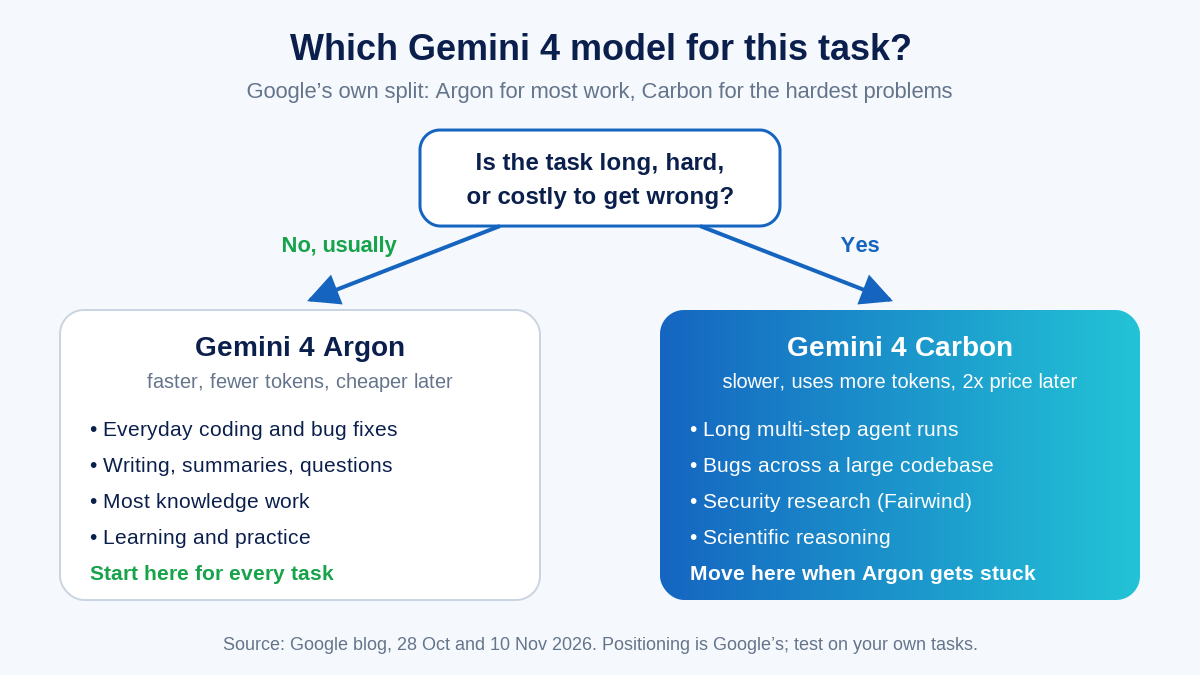
A practical rule: start every task on Argon. If it fails twice on the same problem, or the task is a long agent run where one wrong step costs hours, switch that task to Carbon.
What Google says Carbon is good at
Google's claims, from the two posts:
- Overall: ranked first on version 5.0 of the Artificial Analysis Intelligence Index with a score of 59.
- Long tasks: Google says internal teams have had it run for days on engineering work such as finding and patching bugs across large codebases.
- Fewer made-up claims: in Google's internal testing, Carbon makes unsupported claims at about half the rate of Argon. On a 375-task agentic honesty benchmark it passed 92 percent of tasks, versus 70 percent for Argon.
- Cybersecurity: Google reports 88.2 percent on SEC-bench Pro (finding vulnerabilities) and 71.0 percent on CWE-bench (patching), measured without guardrails.
- Agent benchmarks: first place on CursorBench 4.0, Perplexity's WANDR and Zapier's AutomationBench, at what Google says is more than twice lower cost per task than the next best outside model.
Treat these the way you would treat any vendor's launch numbers: useful for a first impression, not proof for your own use case. Try it on a few of your real tasks before you move anything important.
Price
The price is the part most people search for, so here it is exactly as Google states it.
| Period | Input (per 1M tokens) | Output (per 1M tokens) |
|---|---|---|
| Introductory, until 30 November 2026 | $2 | $10 |
| From 1 December 2026 | $4 | $20 |
The introductory price is the same as Argon's. The 28 October post adds that cached input tokens are 95 percent cheaper, so prompt caching matters even more on Carbon than on Argon if you reuse a long system prompt or document. The later price applies to the publicly available model. Prices are Google's and may change, so check the Gemini API pricing page before you budget.
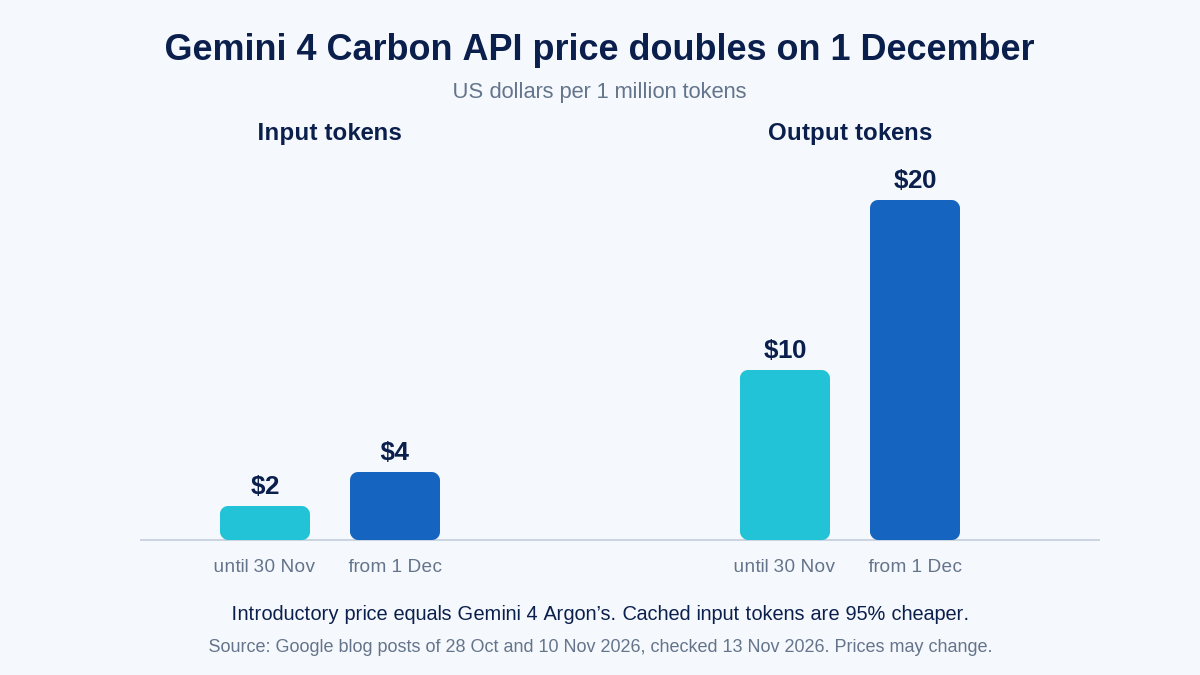
Because Carbon also uses more tokens per task than Argon, the real cost gap between the two on the same job is larger than the price table alone suggests.
Who can use it, and where
As of 10 November 2026:
- Developers: through the Gemini API paid tier in Google AI Studio, and in Android Studio. The model id in AI Studio is
gemini-4-carbon. Google does not mention free-tier access. - Businesses: through Gemini for business, Google Antigravity (Google's agentic coding tool) and CodeMender.
- Consumers: Google AI Ultra subscribers get it in the Gemini app, in AI Mode in Search and in Antigravity. Other Gemini app plans keep Argon.
- Cyber defenders: Carbon's cyber capabilities are gated behind the Fairwind Program, which accepts applications on a rolling basis.
- Scientists: researchers can apply for six months of free access to Argon and Carbon through Antigravity's highest usage tier, subject to eligibility, capacity and selection.
Google does not state Carbon's context window in either post, so we are not quoting one. Check the model page in AI Studio for the current limit.
How to try it in the API
If you already use Argon through the Gemini API, switching is a one-line change: set the model to gemini-4-carbon. Keep the rest of your request the same, then compare the answer, the time taken and the token count in the response's usage data against Argon on the same prompt. We have not run this ourselves, because Carbon is only on the paid tier; the model id is the one Google links to from its announcement.
Three things to watch in that comparison:
- Output tokens. Carbon's longer reasoning shows up here. Multiply by the output price to see the real cost per task.
- Time to first answer. For a chat product, a slower model can feel worse even when it is more accurate.
- Accuracy on your own hard cases. Collect ten tasks where Argon failed and see how many Carbon gets right. That is the only benchmark that matters for your product.
What this means if you are learning AI
If you are a student or a freelancer, you do not need Carbon. The everyday work of prompting, image and video generation, writing and most coding is served well by Argon-class models from any provider, and that is where the price is low enough to practise freely. What is worth noticing is the pattern: every major lab now ships a fast, cheaper model for daily work and a slower, more expensive one for hard problems, and the skill is knowing which task deserves which. Routing cheap tasks to the cheap model is one of the simplest ways to cut an AI bill, and it works the same way for Claude and OpenAI models.
Frequently asked questions
Is Gemini 4 Carbon free?
Not in the API: Google says it is available through the paid tier of the Gemini API in AI Studio. In the Gemini app it is included for Google AI Ultra subscribers. Scientists can apply for a six-month free access programme, subject to selection.
How much does Gemini 4 Carbon cost?
$2 per million input tokens and $10 per million output tokens until 30 November 2026, then $4 and $20. Cached input tokens are discounted by 95 percent, according to Google's 28 October 2026 post.
Should I replace Argon with Carbon?
Google says no for most work: Argon remains the better choice for most software engineering and knowledge tasks. Use Carbon for long agent runs, hard multi-step problems, security research and scientific reasoning, where its extra tokens buy a better answer.
What is the Fairwind Program?
Google's application-based programme for cyber defenders who want Carbon's cybersecurity capabilities. Google is phasing in trusted partners on a rolling basis rather than opening those capabilities to everyone.
- #gemini
- #gemini 4 carbon
- #gemini 4 argon
- #google ai studio
- #ai news
Want a full course on this?
AI for Everyone
Use ChatGPT, Claude and Gemini properly for study, work and daily tasks.
Join the free waitlistWant to learn AI video properly?
The AI Content Creator Program takes you from your first prompt to a portfolio you can show: 27 short, focused lessons in easy Urdu, with a weekly live session and tasks our team reviews.
Enroll now