How to build an AI video portfolio when you have no clients yet
No clients yet? Make three spec projects from realistic briefs, present each as a short case study, and be open about AI use. A step-by-step plan.
Saqqa Academy team
15-Nov-2026 · 5 min read
In this article
You don't need clients to build an AI video portfolio. You need realistic briefs. Pick three kinds of business you would like to work for, write a short brief for each as if a client had sent it, make the video, and present every piece as a mini case study: the brief, what you made, how you made it, and what you would change. Label them honestly as self-initiated (spec) work and say that AI tools were used. A small portfolio that shows how you think gets taken more seriously than a long reel of random clips, because the person hiring is trying to picture you solving their problem.
This plan works whether you want freelance clients or a job where the company asks for work samples. It won't guarantee either. It gives you something specific to show when someone asks, "Can I see your work?"
Step 1: Choose three business types, not three styles
Beginners often build a portfolio around what looks cool: a sci-fi scene, a dragon, a dramatic trailer. Those are fun to make, but a bakery owner can't see their business in a dragon.
Instead, choose three types of business that buy short videos, for example:
- a food or sweets brand that needs product ads for Instagram
- a clothing or jewellery shop that needs reels showing the product being worn
- a local service, such as a clinic, school or real estate agent, that needs a short explainer
Pick the ones you'd genuinely enjoy working with. Three is enough to show range without spreading yourself thin. If you later find a niche you like, you can replace the other two.
Step 2: Write a brief for each one before you make anything
A brief is a few lines that a client would send you. Writing it first stops you from making a video and then inventing a reason for it. Keep it this short:
Business: a small home bakery selling custom cakes
Goal: get more orders for birthday cakes on Instagram
Format: 15-second vertical reel, no voiceover, text on screen
Must show: a finished cake, the cake being cut, the order details at the end
Tone: warm, homemade, not too polished
If you've used a business's real products, logos or name, ask before you publish. Many beginners make spec work for a made-up brand instead, which avoids the problem entirely. A friend or relative with a small business is another option: you can make something for their real product, with their permission.
Step 3: Make the piece, and keep your working files
Make the video with whatever tools you use. While you work, save three things you'll need later:
- the starting images or frames you generated
- one or two prompts that worked well
- a screenshot of your editing timeline
These become the "how I made it" part of the case study. They're also your proof that the work is yours.
If your clips come out floaty or random, our guide on writing image-to-video prompts covers the most common fixes.
Step 4: Present each piece as a short case study
This is where most portfolios fall short. A video with no context tells the viewer what you made but not why. Give every piece the same four parts:
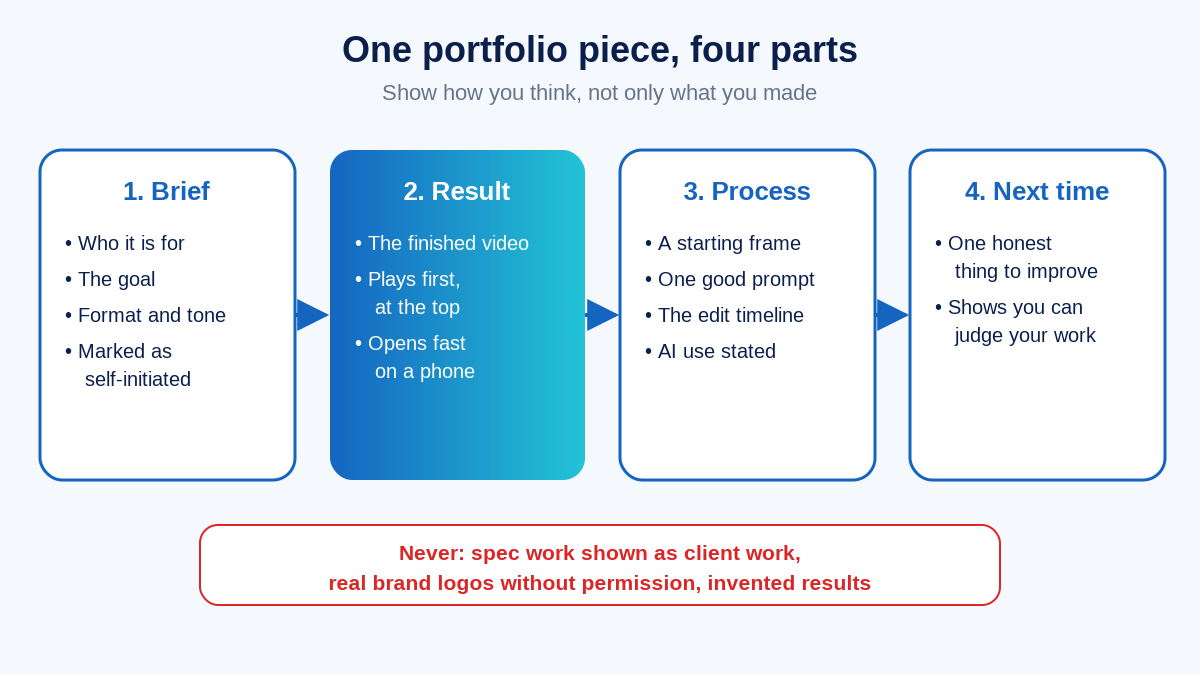
- The brief: two or three lines from Step 2. Mark it clearly: "Self-initiated project, not a paid client."
- The result: the finished video, at the top where it plays first.
- The process: one starting frame, one prompt, one screenshot of the edit. Keep it short.
- What I'd change: one honest sentence, such as "The hand movement in shot 3 still looks unnatural; next time I'd keep the hands out of frame." This shows you can judge your own work, which is what a client is paying for.
Write it in plain words. The person reading may be a shop owner, not a video expert.
Step 5: Be open about AI and about what's spec work
Two kinds of honesty protect you here:
- Say that AI tools were used. Platforms increasingly ask for this too: YouTube, for example, requires creators to disclose realistic AI-generated or altered content (checked 15 November 2026). Clients will find out anyway. Being upfront builds trust; being caught hiding it ends it.
- Never present spec work as client work. Don't put a real brand's logo on a piece and imply they hired you. "Self-initiated" or "concept for a bakery" is honest and is completely normal in creative portfolios.
Don't add invented results either. "This reel got 50,000 views" or "sales went up 30%" only belongs in a portfolio if it really happened and you can show it.
Step 6: Put it where people can open it on a phone
Most people will look at your portfolio on their phone, often straight from a WhatsApp or Instagram message. Choose one simple home for it:
- a pinned Instagram highlight or a set of pinned posts
- a free portfolio page or a simple website with one page per case study
- a shared folder works in an emergency, but a page with the brief next to the video is clearer
Whatever you pick, test the link on your own phone over mobile data. If a video takes too long to start, compress it or upload it to a video platform and embed it.
Step 7: Replace, don't pile up
Once you have three pieces, the next step isn't a fourth random clip. It's replacing your weakest piece with a better one, or with your first real client project. Keep the portfolio short and strong. When you're ready to approach businesses, our guide on finding your first client for AI video work picks up from here.
Frequently asked questions
How many pieces should a beginner's portfolio have?
Three good case studies is a solid start. It shows range without asking a busy person to watch ten videos. Add more only when they're better than what's already there.
Is it okay to use famous brands in spec work?
It's risky. Using a real brand's logo, product or name can make it look as if they hired you, and it may break their trademark rules. Use a made-up brand, or get permission from a real business you know.
Should I say my videos were made with AI?
Yes. Clients usually hire AI video creators precisely because the work is AI-made, so there's nothing to hide. Some platforms, such as YouTube, also require you to disclose realistic AI content. Being open about it is part of being trustworthy.
What if my first pieces aren't very good?
That's normal. Publish your best three now, note what you'd improve, and replace them as you get better. A portfolio is never finished. It should always show your current best work.
- #ai video portfolio
- #freelancing
- #spec work
- #ai video
- #careers
Want to learn AI video properly?
The AI Content Creator Program takes you from your first prompt to a portfolio you can show: 27 short, focused lessons in easy Urdu, with a weekly live session and tasks our team reviews.
Enroll now